
Cancer
Prevention and Vitamin D
By Don Bennett, DAS
Just like my in-depth article on B12, this piece on vitamin D is not short 'n sweet, and this is for two reasons: 1) There's some misinformation about vitamin D, and clearing up misconceptions about health issues is one of the things I do, and 2) It's vitally important that you have correct information about the things that can have a huge impact on your health, your quality of life, and your longevity, and vitamin D is one of those things.
There has been a lot of buzz about vitamin D's role in cancer prevention. This has actually been known for a long time but only now are there studies to back it up. The statement that sunshine is a requirement of vibrant health is viewed by some as nonsense because we all know that sunshine causes skin cancer, right? Wrong! Sunshine is not only not the primary cause of skin cancer, but the vitamin D produced in your body from sun exposure helps your body to stay ahead of cancerous cells so that you never get a diagnosis of cancer. But these diagnoses make a lot of money for some very powerful and influential industries, and the burgeoning markets for cancer prevention drugs (that "may" help prevent cancer) only add to the importance of keeping the information on natural ways to prevent cancer away from the general public.
But the truth is out
there for those open-minded enough to hear. Listen to what one of the
researchers has to say about vitamin D and cancer, and about a "more
rational approach to cancer screening".
|
|
Researchers at the Moores Cancer Center and Department of Family and Preventive Medicine, UC San Diego used a complex computer prediction model to determine that intake of vitamin D3 would prevent 58,000 new cases of breast cancer and 49,000 new cases of colorectal cancer annually in the US and Canada. |
Imagine, screening for disease by looking for nutritional deficiencies! This "pre-actionary" approach is in stark contrast to today's reactionary medicine which says wait until you find something – either through testing or symptomatic expression – and then manage it with medications, surgeries, and therapies.
Studies have shown
sufficient vitamin D levels are linked to a reduced risk of a variety
of cancers. Vitamin D is important for healthy cell growth and for cellular
communication which reduce the risks for some types of cancer. The American
Journal of Public Health reported that researchers searched the Pub Med
database and found a number of observational studies of vitamin D status
in relation to cancer risk dating from 1966 to 2004. Thirty of those studies
focused on vitamin D and colon cancer, 13 on breast cancer, 26 on prostate
cancer, seven on ovarian cancer, and several that assessed the association
of vitamin D receptor genotype with cancer risk. After their review, the
researchers concluded that the majority of the research demonstrated a
protective relationship between sufficient vitamin D levels and a lower
risk of cancer. The key word there is "sufficient". The amounts
of vitamin D that are added to fortified foods are only enough to help
prevent rickets (more on this in a moment), they are not enough to provide
that protective mechanism described above.
| The Mayo Clinic reported that overall 93% of 150 schoolchildren and adults were deficient in Vitamin D, this in a Minnesota-based study. Within that same study, the Mayo Clinic found 100% of African-Americans, East Africans, Hispanics and Native Americans were deficient. This is truly a pandemic of staggering proportions. |
If you are living in accordance with your biological imperatives – which means among other things that you are getting sufficient vitamin D – your chances of being diagnosed with cancer are dramatically reduced, often to zero. When the average American is tested for vitamin D, they come up short; they are deficient in this vital nutrient, even though many processed foods are fortified with vitamin D. Vitamin D is a nutrient that cannot be obtained from natural, unprocessed, healthy foods – the foods that we are designed to eat. This is because vitamin D was expected to come from sun exposure, and who knew that one day people would be living in geographic regions where this was not possible during a portion of the year, or that even during warm, sunny weather people would be spending a majority of their time indoors instead of outdoors, and that scare tactics would be used to discourage people from getting adequate sunshine during the warmer months. So if vitamin D plays an important role in cancer prevention, and most people are deficient in this nutrient, then the result would likely be a predisposition to cancer (and other diseases) which is exactly what we have today. This result has become big business for various industries, but it's bad news for those who suffer from it. Unfortunately in this country the bottom line is "profits before people" (not my words)*. The good news is: now YOU know about the benefit of vitamin D in the prevention of cancer. Put it to good use, and pass it on. (In a moment I'll outline a prudent vitamin D strategy.)
 |
"The population of the world has been brainwashed by the American Academy of Dermatology and the sunscreen industry for 30 years with the unrelenting message that you should never be exposed to direct sunlight because it is going to cause serious skin cancer and death. ... Sensible sun exposure decreases the risk of malignant melanoma." – Dr. Michael Holick |
 |
Even Whole Foods unknowingly perpetuates the disinformation.
(Sun is great for skin because D and other nutrients are made in the skin! Just don't burn.)
 |
In this six minute video you'll hear some facts about the benefits of vitamin D and some of the misleading propaganda, including my favorite, a quote from the American Academy of Dermatology where they say, "It's appalling that anyone in good conscience could make the claim that intentional sun exposure – for any length of time – is beneficial." |
By-the-way,
the above video was deleted from Youtube by Youtube.
What is it they don't want you to see?
|
Where does the "sunshine is bad for health" notion come from? There was a study that demonstrated a correlation between people who got sunshine and those same people having a higher rate of cancers (breast, prostate, ovarian, etc). Huh? If someone cared to read the entire study and not cherry pick specific data that perhaps served their agenda, they would see that those people who got enough sunshine reduced their risk of cardiovascular disease and therefore lived longer, but because their diet and other lifestyle practices weren't equally healthful, since they lived longer, their risk of cancer increased because, in general, cancer risk increases along with biological age... the longer you live, the higher your cancer risk will be. Therefore, because increased sunlight exposure increases your longevity for one reason, it will also appear to increase your risk of cancer. But this does not necessarily mean that sunlight is intrinsically "carcinogenic," which is now commonly assumed in some circles. But if besides getting appropriate amounts of sunshine/D you also pay equal attention to the other basics of health, your cancer risk will decrease along with your risk of cardiovascular disease. |
But what else is vitamin
D good for? It's a well known fact that without sufficient vitamin D,
all the calcium in the world wouldn't be enough to keep you from getting
osteoporosis; vitamin D being necessary for good bone health. And vitamin
D also plays a role in the prevention of other chronic, degenerative diseases.
And that's something to think about: these conditions are all very slow
in getting to the point where you become aware of them. A vitamin D deficiency
is not like an oxygen deficiency, which you'd know about immediately.
So we go through life slowly degenerating and assuming that it's simply
part of getting older, and that it's nothing unique or personal because
it happens to everyone. But if everyone is sub-clinically deficient in
vital nutrients, and if everyone is not supporting their body's efforts
in staying ahead of serious illness, and if everyone is doing the things
that unknowingly cause these diseases, then it's only natural that everyone
would degenerate over time and get that dreaded diagnosis of something
serious at some point. So if vibrant health is something you'd like to
invest in and experience, it's crucial that you trash any notion that
serious disease is inevitable, because this can become a self-fulfilling
prophecy for people who believe it.
| Here's
a sample of serious health issues people face with chronic vitamin
D deficiency:
Cancers
– increased risk and severity of 11 types of
cancer, including melanomas. Adequate vitamin
D has been shown to make cancers cells lose their blood supply and
thus their ability to expand. It also inhibits cell growth, inducing
what's called ‘cell apoptosis' (inability to divide) in breast
cancer, prostate cancer, and osteosarcoma. |
It's interesting how all the recent health care reform discussions have shed light on the fact that we here in the USA are doing far worse than folks in other countries (who have a better health care system than we'll likely ever have). The U.S. is 19th in infant mortality, we're 35th in average life expectancy (out of 191), we're the most overweight country in the world, and not surprisingly we're the sickest people when it comes to the preventable diseases of lifestyle. And mostly you have a for-profit ill-health management system to thank for this, because a true health care system would include education that would make it perfectly clear that a high fat diet and insufficient exercise, sunshine, and sleep are public health enemy number one.
|
You Want Studies? Studies have shown that sufficient vitamin D levels are linked to a reduced risk of a variety of cancers. Researchers searching the PubMed database found it contained 63 observational studies of vitamin D status and cancer risk from 1966 to 2004. Thirty studies on D and colon cancer, 13 on breast cancer, 26 on prostate cancer, and seven on ovarian cancer. The researchers concluded that the majority of the research demonstrated a protective relationship between sufficient D levels and a lower risk of cancer. |
True Health-Care is Self-Care
When I find myself among those discussing the current health care issues, I'm often asked what I think is the best health care system. Knowing what I know about the health care system we've had and will likely continue to have*, and knowing what I know about disease avoidance and health creation, there is no contest: the absolute BEST health can only be had when you take responsibility for your own health care. And yes, that places the care of your health on you, but if you place your health, your quality of life, and your life itself in the hands of those not properly educated in health creation and disease avoidance, you will likely get what the average customer of the traditional health care system gets: a life expectancy less than your actual longevity potential, and a quality-of-life in the "winter" of your life that is far less than what it could be. And telling yourself that this is what most people experience isn't going to make it feel any better. When I'm in the last fifth of my life, I want to feel as great as I did when I was in the first fifth, and I'm willing to do what it takes to accomplish this. And the good news is, what it takes is both enjoyable and delicious.
And since death is
inevitable, I want to die of non-specific organ failure, i.e. "natural
causes", not some all-too-common serious disease accompanied by diminished
quality-of-life. Natural causes or "old age" was once the major
cause of death. You went to bed one night at a ripe old age, in reasonably
good health, and simply didn't wake up the next day. That's for me! But
we've been conditioned to believe that serious illness is the norm and
is unavoidable. But this is simply not true.
|
Who is at risk of Vitamin D deficiency? Certain people are more likely to have vitamin D deficiencies including: breast-fed infants, the elderly, people with dark skin tone, people living in latitudes far from the equator, those not eating a diet fortified with vitamin D, and those who are obese. In certain countries, clothing, for cultural dress or weather conditions can also limit the exposure to sunlight and thus to vitamin D. Even in sunny areas, those people who tend to work or play indoors, or wear sunscreen when outdoors, can have vitamin D levels that are too low. Also at risk are people eating foods that have been sprayed with Roundup (a pesticide). It has been proposed that the current vitamin D deficiency epidemic is caused by glyphosate, due to glyphosate's interference with CYP enzymes. 25-Hydroxy Vitamin D is the product of activation in the liver by a CYP enzyme. And to add insult to injury, these enzymes are needed for other very important functions in the body. So this is one of many reasons to only eat foods that are organically grown. |
Vitamin D "How To's"
How do you make sure your vitamin D level is providing optimal protection? Simple; live in the tropics. If you do, there's not much to think about regarding vitamin D (unless you wear too much clothing or don't spend enough time outdoors). But for those who can't get adequate sunshine all year-round – sunshine strong enough to produce vitamin D and the other sun-provided nutrients – here's a sound vitamin D protocol for those times when you can't get your D and other nutrients from the sun via daily sunbathing (more on these other sun-provided nutrients in a moment).
1. Get tested. See what your D level is currently. It's good to have a baseline, and not good to simply assume you are low. You don't want to supplement with vitamin D (or any nutrient) if you don't need to. The test to get is called a 25-Hydroxy-Vitamin D test, sometimes referred to as 25(OH)D or Vitamin D, 25-OH, Total. The test you don't want is 1,25-dihydroxy-vitamin D and, unfortunately, about 20% of U.S. doctors order this test thinking that by measuring the most potent steroid in the human body, calcitriol, they are getting useful information, but they are not. 1,25-dihydroxy-vitamin D is an adaptive hormone; it goes up and down with calcium intake. So if 1,25-dihydroxy-vitamin D is normal or high, these docs tell their patients that they are okay on vitamin D when in reality they may be vitamin D deficient, increasing their odds of cancer and other degenerative disease.
The test result range you are looking for is between 50-80 ng/ml. Unfortunately there are some docs who see a reading of 30 ng/ml as being "okay", but current research shows that this is too low. Some researchers have a more conservative range of 40-60 (this may be due to a concern that D is fat soluble, and therefore taking too much and having too high a level can result in vitamin D toxicity; more on this in a moment). But all my research suggests that if you keep tabs on your D level, the range of 50-80 ng/ml is a safe one to shoot for (and this does not require weekly or even monthly testing).
And just to point out how there can be misinformation even about something that should be well settled, and is not a matter of opinion, here are some of the various recommendations you will find when researching the "okay" vitamin D range...
10 to 55 ng/mL – Philip Batty, M.D. (not a typo!)
16 to 74 ng/mL – healthguide.howstuffworks.com (also an insane range)
25 to 50 ng/mL – answers.com (50 should be the low end!)
30 to 80 ng/mL – NIH (National Institutes of Health - U.S. government)
40 to 65 ng/mL – Mark Hyman, M.D.
50 to 80 ng/mL – reality-based health practitioners
|
Two different measurements used In the U.S. the vitamin D test measures in "ng/ml". In the UK and Europe the test uses "nmol/L" or "ug/L". The optimal range to be in is: 50
- 80 ng/mL (this is the measurement type
used in this article; also called ug/L) The conversion factor is 2.5, meaning, to convert from one to the other, simply multiply or divide by 2.5 NOTE: If you see a test result measured in ug/l, this is the same ratio as ng/ml, and therefore the same ranges can be used. |
|
Two different testing methods used Many blood tests must conform to a standard so that a test result from one lab can be compared to the test result from another in an apples-to-apples manner. Unfortunately, the 25-Hydroxy-Vitamin-D test is not one of those tests. Of all the labs in the U.S. one lab uses a different testing method than all the others, making their results essentially inaccurate (because you can't compare them to the recommendations in this article). The lab that doesn't play well with others is Quest Diagnostics. So if your test is performed there, you need to multiply the result by 1.3 to be able to have a meaningful result. If your test is done by Lab Corp (the other big lab chain), your results are accurate. The take-home point here is: If you get tested at a doctor's office, don't be shy about asking for the name of the lab that does your D test. (And don't be surprised if the doc doesn't know about this issue.) |
As Dr. Garland in the above video suggests, get tested through a health care professional, or get a self-test kit and do it yourself. I would add that if you are supplementing with a meaningful amount of vitamin D, since it is prudent to test every two months until you find what dose gets you in the 50-80 range while supplementing, it is important to get tested using the same lab or with the same test kit each time so you are comparing apples-to-apples. There is a through-the-mail test kit available here, and a more accurate test can be done at a lab where blood is drawn, and in most states in the US you can do this without a doctor's order by buying the test from here (and I have no affiliation, financial or otherwise, with these companies or the vitamin D manufacturer that I recommend).
Besides getting a baseline, a better reason to test for your D level before you start supplementing is to see just how deficient you are if you are deficient. If you're only a little deficient ("insufficient"), then the dose of your D supplementation could follow the guidelines in this article (maintenance dose). But if you are seriously deficient, you'd want to know this because your initial dosing of D should probably be more along the lines of a therapeutic dose which will taper down to a maintenance dose as your levels come up.
2. If low, raise it (enough but not too much) If you are low in D and you can get out in strong enough sunshine, do so. Just don't get burned.
|
How much sunshine? The second video above mentioned 15 minutes in the sun in a bathing suit in summer is plenty, but that only refers to the part of the day when the sun is strongest. Fifteen minutes in a bathing suit in summer but at 10am or 3pm may not be enough, and 15 minutes at high noon in summer in Canada will not be enough (and wherever you are, you should shoot for the hours between 10am to 3pm because that's when the best "D making" wavelengths occur, just be careful not to burn because the "burning" rays are there too). And how light or dark your skin tone is also affects the amount of time you should sun yourself, as does cloud-cover, altitude, and time of year. So the above statement is a conservative one and errs on the side of caution. But since avoiding a sunburn and getting adequate sunshine-provided nutrients is the goal, how to get enough but not too much D-producing sunshine cannot be summed up in a short statement. How do I know when enough is enough when sunbathing? I listen to my body, and I can feel when I've had enough. If you are not at the point yet where you can do this, I'd err on the side of caution so you don't get burnt. So as you can see, anyone who gives you definitive amounts of time or times of day to sunbathe doesn't understand that there are too many variables to do this with any degree of accuracy, but since people want this type of advice, this type of advice will be available. And speaking of bathing suits, wear one of these when sunning yourself to get a more even tan and to make the most of your sunbathing. But keep in mind the following... |
|
Is a tan really healthy, all things considered? A tan is a protective
mechanism. And while it serves to lessen the damage from the sun's
UVA rays (the "damaging" rays), it also has the unfortunate
effect of lessening the sun's UVB rays that make nutrients in the
skin (nutrients that cannot come from food or supplements). And
we're not just talking about vitamin D. |
|
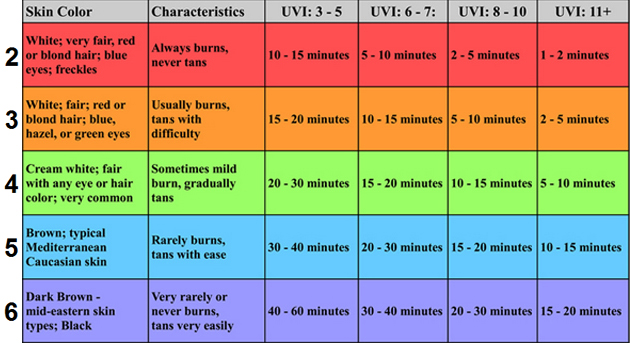
How much sunshine - Part 2 You can also use your daily UV Index to get an idea of how much time to spend in the sun on each side when sunbathing. The daily UV Index for your area is available online here. And keep in mind, that eating the diet we're all designed to eat will lessen the risk of burning (meaning that unhealthy diets increase the risk of burning, making it more difficult to get enough sun-provided nutrients, which decreases health).
NOTE: If you have a weather app on your phone, there’s a good chance it can tell you the UV Index. This is the most convenient way to check. Android devices don’t have one standard weather app, but there is a weather web app built into Google Search. Simply open the Google app and search for “weather.” The result will be for your location, and you can expand the result to see UV Index. |

If you can't get out in the sun because it isn't strong enough, I'd consider getting a phototherapy device (artificial sun lamp array) which is the best option. The other option is supplementing with vitamin D3 (but it only provides D and not the other equally important essential nutrients that sunshine provides). D comes in drops, which might be preferable over tablets when taking 6,000 IUs; just make sure not to get drops that use fish oil (coconut oil is preferable). The drops you can get here. And Vitashine's D3 that is claimed to be a vegan D3 is here. But again, a D supplement is not the best option if you want optimal health.
A well-designed narrow band phototherapy device is the SolArc model E720M-UVBNB shown here. (Note: I do not sell these items, nor do I make any money from their sale if you buy them via these links.) This phototherapy device is a "starter" unit that can be added on to as finances allow (reducing exposure time requirements). And one benefit it has over the sun is that it maximizes the nutrient-producing wavelengths and minimizes the wavelengths that cause burning. Expensive you say? Think of it as an investment in your future health. Plus, how "costly" is a diagnosis of a life-threatening disease? Just say'n.
 |
You can also suspend the SolArc unit from the ceiling so you can lay under it, but you wouldn't be under it for very long, so I would just use it as shown. The unit as shown is about $1,200. Add a second 2-bulb unit for better coverage when you can. Speaking of "better coverage", we were designed to get sunlight on our entire body, so since you're in your home, try "nude sunbathing". Note: Since the US's FDA requires a prescription for a device sold as a "phototherapy device" you'd need a doctor's prescription to accompany the order for this Canadian company if you live in the US. Simply explain that you want to improve your "vitamin D status" and you don't want to take oral supplements. If that doc won't write you a prescription for the "E720M-UVBNB phototherapy device", find one who will. |
|
A more affordable unit is this one from Sperti for $599 (think of it as an investment in your future health). It's the one I use daily. Video here, but unlike the actors in the video, you shouldn't wear any clothes. And the recommendation to use it "every other day" is only in the beginning. After a while, daily use is fine and beneficial. But as with all phototherapy devices, more is not better. More info here. And tanning beds at a tanning salon aren't likely to make any nutrients in your skin... those things will just tan you. Why? The beds are cheaper for the salons to buy, and since they aren't phototherapy devices, there are no regulations the salon must follow. And after all, people are coming there wanting a tan, not vitamin D. So why should a salon buy the more expensive phototherapy devices that only make nutrients and don't tan you? |
 |

Although not the best option, we still must talk about how much supplementary D to take. That is the million-dollar question. There is some controversy on this issue, which is why I highly recommend that you monitor your levels until you discover the dose that gets you in the range you should be in (50-80 ng/ml, 125-200 nmol/L with the "sweet spot" being 65 ng/mL and 162 nmol/L). Unlike water soluble vitamins, like vitamin C, you can get symptoms of vitamin D toxicity if you take too much (a list of which I include at the end of this article). Obviously this is to be avoided, but avoiding it by taking only the dose recommended on the bottle or by the USDA or some other agency may not yield the amount of vitamin D that your body needs to effectively prevent disease, both chronic (like cancer and osteoporosis) and acute (like a cold or the flu). And emerging research indicates that current mainstream recommendations are indeed too low. (Same goes for using a phototherapy device; test your D level after two months of consistent use to see if the amount of time you're using it brings your D level into the optimal range of 50-80 ng/mL, with the "sweet spot" being 65 ng/mL).
If you're not getting any meaningful sunshine (sunshine that could burn you if you over-did it), and you don't have a phototherapy device yet, the current recommendations by the Vitamin D Council are "healthy children under the age of one year should take 1,000 IU per day; over the age of one, 1,000 IU per every 25 pounds of body weight per day; healthy adults and adolescents should take at least 5,000 IU per day. Two months later, have a 25-hydroxy-vitamin D blood test" (to ensure you are in the 50-80 ng/ml range). Those are the recommendations I follow. But at the other end of the spectrum is the IOM (Institute of Medicine) recommendation of 600 IUs a day (up from 400 IUs because rickets has made a come-back).
Keep in mind that sunshine can deliver 10,000 to 40,000 IU per day of vitamin D without the risk of overdosing. If you feel that supplementing with 5,000-6,000 IU per day sounds too high, being that the vitamin D bottle says 2,000, it would certainly be prudent to take 2,000 per day and see if that amount raises your level into the 50-80 ng/ml range. If it doesn't, increase to 3,000 a day and test again in two months, etc. If you decide to follow the above recommendations of 5,000 per day for adults and adolescents, be sure to test no later than two months after starting supplementation. If you get a reading over 80 ng/ml, adjust your D intake down accordingly and re-test in two months.
Okay, all that being said, I will tell you that at doses of 6,000 IU per day, I have never seen any symptoms of vitamin D toxicity. But if you experience any (see below), discontinue D supplementation until symptoms disappear, keeping in mind that the long half-life of vitamin D – approximately 30 days – would result in the side effects taking a while to disappear after you stop supplementation. It is not uncommon for side effects to fade slowly over the course of a few weeks. A standard protocol in the case of vitamin D overdosing is to not only avoid vitamin D supplements, but also vitamin D fortified foods, sunshine, and calcium supplements for a few weeks, while increasing water intake and physical demands (through vigorous exercise). Remember that healthy, natural foods (fruits and green leafy vegetables) contain no vitamin D. Also, I'd advise getting an immediate 25-hydroxy-vitamin D test to see just where your levels were when you started experiencing symptoms. Besides being good data to have in cases of deficiency and excess, the test is an especially good idea if the symptoms you are experiencing are not actually being caused by vitamin D toxicity. This comes under the heading of being an educated consumer, and when it comes to symptom diagnostics, you don't want to be misdiagnosed, which happens more often than you might imagine (remember, some docs believe a reading of 30 is good, and some misdiagnose symptoms of low D. And also remember, a D supplement only provides D and none of the other equally important sunshine-provided nutrients... so if you really care about your health, don't take a D supplement; get a phototherapy device for your winter months).
Vitamin D's Co-workers
One last word about over-doing vitamin D supplementation: If you become symptomatic, it may not be that you are getting too much D, it may be that you are not getting enough magnesium and other "companion nutrients" of D. There are other nutrients that need to be present in sufficient quantities for vitamin D to do its job, like zinc, vitamins C, A, and K2, boron, and magnesium. Magnesium is the most important of these co-factors where it concerns D. In fact, it is common for rising vitamin D levels to exacerbate an underlying magnesium deficiency, increasing "neuromuscular hyperexcitability" of which its primary cause is the magnesium deficiency, not the increase in D. So if you're experiencing problems when you start supplementing with vitamin D, a magnesium deficiency could be the reason why. The best way to ensure that you are getting enough magnesium (and zinc and boron, etc) is to take a high quality worthwhile multi. I take this (I don't sell it).
Not to put too fine a point on this, but, a vitamin never works alone; it has various relationships with other vitamins in order to work properly. And if you're deficient in magnesium, you could be taking an otherwise "okay" dose of D but still experience D deficiency symptoms such as headaches, insomnia, jitteriness, muscle cramps, anxiety, heart palpitations and/or constipation, and your D level might not improve when taking the D supplement. Those who are eating a healthy diet that contains lots of uncooked fruits, non-sweet fruits, and green leafy vegetables may or may not be be getting enough magnesium (was there enough in the soil that fed those crops as they grew?), but those eating a Typical Western Diet may not (probably not) be getting enough. As I said, to ensure an adequate supply of magnesium, and the other D co-factors, a high quality multivitamin is probably a good idea; I am not an advocate of buying a bottle of magnesium tablets any more than I advocate buying bottles of chromium (which is vital in the proper regulation of blood sugar metabolism), but you may have to do this when correcting a very low D level. Why? The increased D will increase D utilization which will require above normal amounts of D's companion nutrients for a while... amounts that are higher than food can normally supply. This unnatural scenario is only because of the unnatural D deficiency which would have never happened if you had been living in your natural environment.
|
"VITAMIN D IS RAT POISON" You may have
heard this, that cholecalciferol (used as D in vitamin D supplements)
is rat poison. Let's be fair and balanced, cholecalciferol is used
in rat poison because it helps kill rats, but it's not "rat
poison". Yes, when ingested in large enough quantities, it
can be unhealthy for humans, and this is what happens when rats
consume it in the quantities they do. The amount in a dose of rat
poison is 50mg; the amount that humans are recommended to take is
0.125mg per day. Dose matters, but not to those who go around shouting
that a D supplement is rat poison. |

|
D2, D3, and "Vegan D3" – UPDATED For a long time
there have been two types of supplemental D; D2 and D3. This could
be a whole article in itself, but let it suffice to say that D3
is the effective form of supplemental D. The reason D2 is marketed
is because it is the vegan form of supplemental D (D3 is made from
the lanolin from sheep wool), but like a lot of products that are
marketed to the health conscious and vegan crowds, D2 doesn't "do
it"; D2 doesn't raise your D level to where it needs to be
in order to be effective in helping to prevent degenerative disease.
You'd have to consume an impossible amount of D2 to get your blood
level above 50 ng/ml. D2 (ergocalciferol) has lower bioactivity,
poorer stability, and shorter duration of action. So when this information
became better known, there was a demand for a vegan D3, and industry
was only too happy to oblige. The problem is, there has been some
doubt as to whether there can be a truly vegan D3 supplement. D3
products that claim to be vegan are made from mushrooms or lichen,
which would define them as vegan, but when non-vegan D3 is "fed"
to the mushrooms or lichen, the end product may be vegan, but it
is not a 100% vegan product start-to-finish. So "vegan D3"
can be made using a non-vegan source. One company that manufactures
a "vegan D3" supplement even admits this in their product
description, but is of the opinion that their product is "vegan".
While I applaud their honesty, I don't agree with their opinion.
(Note: This company has since removed the text that explained exactly
how their product is made.) Another company who claims their D3
product is vegan states that no animal products are used in the
manufacture of their product, which would make it a truly vegan
D3 product. Their product has the UK Vegan Society's stamp of approval.
While this in and of itself doesn't guarantee that their product
is vegan, there has been some research that suggests that this company
is able to make a truly vegan D3. More on this issue in this video. By-the-way, if you're wondering why some noted health educators and vitamin D experts are saying that D2 is just as effective as D3 at raising blood D levels, it may be because we humans have the ability to have our judgment colored by our personal biases and philosophies. And nowhere is there a more fiercely defended philosophy than veganism (and rightly so, to a certain extent). You should know that I won't go to zoos, aquariums, or circuses, I don't like the idea of a "pet" industry, and I don't wear anything made from animals, but I also don't allow my personal beliefs and values to affect my research. But I've found that some health educators and researchers do, which is why they give a thumbs up to things like D2 and soy products. And also, mushrooms are not a good way to provide D. This is an old meme that's still floating around today, but it needs to go away because science has weighed in on the subject of the best way to provide D when the sun can't. |
|
A potentially dangerous assumption Some people make the mistake of assuming that as long as the sun is "out" and the sky is clear, that they can sun themselves if they can tolerate the cold temps, and they will get some D and the other sun-provided nutrients. Not so. We're designed to live close to the equator where the "winter" sun will still be strong enough to make D in skin. If the temps are getting cold... if you are having to wear more layers to maintain a tropical environment next to your skin temp-wise... the sun will be at an angle where it will be shining through too much atmosphere for its rays to be strong enough to make meaningful amounts of D in your skin, even at high noon. This time of year is known as your "vitamin D winter" where you either have to temporarily relocate, or get your D from another source like a phototherapy device (or a D3 supplement, which is not recommended).
If you live outside the yellow area, you will not get enough meaningful sunshine all year around, and will need to supplement with a phototherapy device (best), or D drops (second best). Notice, I didn't say "you may not". We evolved in that yellow area (right in the middle), and were never meant to live elsewhere (oops!). |

Overdosing by doctors
If you have your 25-hydroxy-vitamin D test done by a health care professional, and the results are very low, he or she may prescribe 50,000 IUs once a week. This has been shown to be a potentially problematic dose, and is ill-advised in my opinion; it would be better to simply adhere to the dosage recommendations of 5,000-6,000 IUs a day and re-test in two months.
Enough D from Fortified Foods?
When it was discovered that rickets – softening of the bones – was caused by a severe vitamin D deficiency, it was mandated that sufficient vitamin D be added to processed foods to prevent this disease among our population. While those amounts that are added to processed foods will prevent rickets, it is now obvious that these amounts are inadequate to help prevent the more chronic, degenerative diseases that vitamin D insufficiency contributes to. And if you're like the many people who are discovering that processed foods are not a healthy part of the human diet, and are avoiding them mostly or totally, you need to be vigilant regarding the nutrients that you are now no longer getting from those processed foods, and that do not come from the healthier foods you are now eating, like vitamins D and B12. D is supposed to come from sunshine, and a healthy body is supposed to manufacture all the B12 it requires. These are the two "problematic" nutrients. (I address the B12 issue in my book.) And by-the-way, rickets is making a comeback! And you can thank computers and their social networks, and Game Boys, and Play Stations for this (kids are spending less time outdoors than ever). The fix? Government is recommending that the 400 IU amount added to fortified foods be raised to 600 IUs which may help to eliminate rickets once again but obviously does little to lower the risks for all the other diseases where insufficient D is a contributing factor.
|
"Why bother with sunbathing if I can just take a supplement?" The sun provides something that can't be put into a pill. HINT: High-end swimming pool filters have a light bulb that exposes the water to UV rays as the water runs through the filter; this disinfects the water (photo below). The sun's UV rays do the same job when they shine through your skin and bathe your blood and lymph fluids as they circulate. Obviously UV-blocking sunscreens prevent this, and also prevent the body's manufacturing of D (but if you need to wear sunscreen to prevent burning, look into this one; it's probably the safest one made. Or if you don't want a store-bought sunscreen, you can try coconut oil or a coconut oil and shea butter mixture). Plus, the sun doesn't just make D in your skin, it also makes D sulfate* and cholesterol sulfate*, which aren't in a vitamin D supplement (D2 or D3). And it appears that the health benefits experienced by the immune system from sunshine may have more to do with D sulfate than with vitamin D as previously thought (so what does that say about taking a D supplement). And strong-enough sunshine also makes beta-endorphins in our skin (a "feel good" hormone), and it makes nitric oxide too (blood pressure regulator amongst other beneficial things). This is obviously why I'm an advocate of a phototherapy device (see above) over a D supplement for those who experience "vitamin D winters" and want the best health their DNA can provide. And this is why, whenever I write about D, I denote it as "D+"... the plus sign represents those other equally important nutrients besides D.
*
D Sulfate – direct immune signaling without
liver activation; raises cathelicidin, ß-defensin; antiviral/antibacterial.
And human breast milk contains D sulfate but not D – suggesting
evolutionary priority for the sulfated form in immune transfer. |

|
The Vitamin D and K2 issue Here's what I know so far about K2. If you're getting enough K1, your body can convert it to K2. There are two thoughts on this: 1) the MK-7 form of K2 can be made in the gut (if you refrain from irritants like garlic, ginger, spicy foods, tea, pepper, alcohol, etc.) but this form appears to contribute minimally to overall vitamin K status, and 2) the conversion of K1 into the MK-4 form of K2 (the one that does the heavy lifting) occurs in the testes, pancreas, and arterial walls and is independent of the gut (but this doesn't mean it's okay to eat things like garlic et al because they do interfere with B12 production). Plus, eating too much overt fats high in PUFAs could also deplete antioxidants, including the K vitamins (Poly Unsaturated Fatty Acids). So far I find no data that says if you take D3 to maintain your 25(OH)D level, you must take K2 with it. Yes, one of K's roles is to transfer calcium from blood and deposit it into bone, and yes, D is needed for bone health, and that's where the association was assumed, but correlation is not the same as causation. And by-the-way, the bone health mechanism is not the same as the enamel health mechanism (because enamel gets nothing directly from the blood supply). So K2 is needed by the body, but D has other co-factors (companion nutrients) that are more problematic, like magnesium, zinc, and boron. And even sufficient iodine plays a role, and many people have an iodine insufficiency. And since these minerals and elements are "essential", meaning the body can't make them and they must come from the diet, I'd look to these first. And this is why I augment the foods I eat with barley grass juice powder to compensate for their minerally sub-par nature due to the way they're grown (but even a "multi" type of supplement can't resolve an iodine insufficiency). And could there
be a downside to taking something like K2 if you don't need it?
It's not like taking in additional minerals, which the body doesn't
make. If you take in more minerals than you require, the body simply
stores what it wants and excretes the rest in sweat, urine, breath,
and feces, which it (hopefully) does even if you don't take a mineral
supplement. But if you take something that is normally produced
by the body, like K2, and the body was making enough of it, one
of two things will happen: 1) there can be a down-regulation effect,
and then if you stop taking it, there will be a deficit for a period
of time until the body (hopefully) up-regulates its own production,
and 2) no down-regulation occurs (because we were never designed
to take in K2 by mouth because we're not carnivores) and now you've
got too much. This happens with cholesterol. This info brought to
you by the department of "all things considered". BTW, this group of vitamins got the "K" designation not because K was the next available letter, but because of the German reference to it of Koagulationsvitamin because of its contribution to blood clotting (which occurs even when only K1 is supplied). Bottom-line: If health restoration is the goal, there are many other issues to explore and deal with first before turning to supplementary K2, such as "sunshine doesn't just make D in your skin, so a D supplement will leave you low in other essential sunshine-provided nutrients", and "are you making sure to get enough of D's companion nutrients?" |

|
The benefits of vitamin D with reducing severe complications and death from viral infections (Want less risk of issues from a viral infection? Make sure your D level is in the optimal range.) The Role of Vitamin D in Suppressing Cytokine Storm in COVID-19 Patients and Associated Mortality (PDF) Vitamin-D and COVID-19: do deficient risk a poorer outcome? Lancet- May 2020 Optimisation of Vitamin D Status for Enhanced Immuno-protection Against Covid-19- 2020 The role of vitamin D in the prevention of coronavirus disease 2019 infection and mortality Vitamin D deficiency contributes directly to the acute respiratory distress syndrome (ARDS)- 2015 On the Epidemiology of Influenza- 2008 Vitamin D3 Supplements in Winter May Help Protect Against Influenza A- 2010 Vitamin D and airway infections: a European perspective- 2016 |
|
"I've tried everything and can't raise my vitamin D level!" Just as a proper
vitamin D level requires companion nutrients, it also requires that
certain organs be working properly, namely the liver, parathyroid
gland, and kidneys. So to have a proper D level, your organs and
glands need to be functioning well too. This is why, when dealing
with ill-health, a whole-body approach is best. And sufficient nutrition
plays a huge role here. |
|
Studies
show that vegans have more fractures than meat eaters Yes, there are such studies that show this. But their conclusions are wrong. They assume it's because the vegan diet (and raw vegan diet) doesn't provide enough calcium and protein. But what these studies fail to take into consideration is that the foods that vegans eat are not fortified with anything, and their meat-eating counterparts eat the typical Western diet that contains processed foods fortified with D (and B12 and iodine), so they can have less fractures than those vegans who live in regions that don't get strong enough sunshine during the winter months (which is who they looked at in these studies). Enough D is needed for strong bones. This is why vegan educators need to step up their game and teach about the importance of maintaining a healthy D level (and B12 and iodine) when people stop eating fortified foods. And BTW, it's laughable that vegans and raw vegans don't get enough protein. By those study's standards, sure, vegans get less protein than those eating the typical Western diet, but those people are getting too much protein! So it's a flawed comparison. And "not enough calcium"? It's possible if the vegan is sedentary. Huh? Yep. Less physical activity means less food eaten which means less calcium consumed, especially considering agri-industry growers only add back to their soils potassium and phosphorous but not any calcium, so sedentary vegans may not be getting enough calcium, and with no physical activity, their bones will be at risk of being weak from that insufficiency, especially with not enough D. (Wow! This sidebar was very enlightening, huh!) |
|
TRUE OR FALSE "The most direct way for the body to receive and convert sunlight into vitamin D is actually through the retina." False. This is a popular myth that can be found in the alternative health community, but it has no basis in fact. Yes, certain eye cells (like corneal epithelial cells or retinal pigment epithelial cells) have enzymes for vitamin D metabolism and can locally activate or even produce small amounts of vitamin D metabolites in isolated cell cultures exposed to UVB wavelengths, but this is local (for eye tissue health, like immune regulation or wound healing) and negligible for your overall body's vitamin D levels. The cornea is more exposed than the retina, and the retina itself gets almost no direct UVB due to natural eye protections. So, the most direct and primary way your body receives and converts sunlight into vitamin D is through exposure of your skin to ultraviolet B (UVB) rays, and the best way to get enough UVB without too much UVA (the "damaging" rays) is to use a phototherapy device 365 days a year. |
Just
wanted to show how even
medical doctors get things wrong
In this doc's Youtube video he not only says that it's fine to get D from animal foods, but he uses the wrong units-of-measure for the vitamin D test. It should be ng/mL. But that's not what it says on his slide. A small thing, but it speaks to his knowledge of the subject matter. And while he points out many of the important roles that D plays in health, he fails to mention that a D supplement (which he recommends) does not contain any of the other equally important nutrients that strong enough sunshine makes in the skin... I'm guessing because he doesn't know about this. So, not the best source of D info.

In Conclusion
Get some of your vitamin D from sunshine but get most of it from a UVB phototherapy device; this lets you have a robust level around 65 ng/mL (162 nmol/L) and this helps you have the best odds of never getting a diagnosis of cancer.
This doctor sums it up nicely:
"Because vitamin D is so cheap and so clearly reduces all-cause mortality, I can say this with great certainty: Vitamin D represents the single most cost-effective medical intervention in the United States." – Dr. Greg Plotnikoff, Medical Director, Penny George Institute for Health and Healing, Abbott Northwestern Hospital in Minneapolis.
It is understandable that a medical doctor would see vitamin D as a "medical intervention", and not know about the superiority of a phototherapy device over an oral D supplement, but his point is an important one. I see adequate D as simply a necessary part of normal human existence, and if we as a population would recognize adequate D, B12, and all the other nutrients as an important part of a healthy lifestyle (and would pay equal attention to all the other basics of health), the need for medical facilities would be primarily for emergency, poison, burn, and trauma care because the incidence of chronic, degenerative disease would reduce dramatically. And this starts by dramatically reducing the risk factors for you. Invest now for your future health!
| Along with two other "problematic" nutrients, vitamin D is one of the things I test my clients for, and it's a mandatory test in my practice. You can use the above vitamin D DIY "guide" to self-diagnose and self-correct, but if you wish to utilize my services for a more comprehensive check of the other problematic nutrients, and for going over your vitamin D situation, along with some insightful counseling, see Health101.org/counseling (articles I've written in the past have not included this paragraph, but there is simply way too much misinformation that is causing people to travel down a path that will ultimately not allow them to be successful with their health restoration and maintenance goals, and only allow them to survive and not thrive, thus my motivation for mentioning my counseling practice). |
 |
Don Bennett
P.S. I did think it ironic that the first video sports a photo of a woman drinking a glass of milk in the opening and closing graphics, because dairy products are a poor source for adequate vitamin D and they are a rocket-fuel for the very cancers that this research is hoping to prevent. More on milk's role in cancer here.
* Watch Bill Moyers Journal "Profits over People" where former insurance insider Wendell Potter speaks candidly about health care reform and the downsides of the health insurance industry. A must-see video! http://video.pbs.org/video/1178899944/ <-- don't bother going there...PBS removed this video!!! It shined too much of a light on the health insurance industry, and that industry's influence over that network got the video deleted. But Bill put it on his own website here. And I had recorded it when it originally aired, so if it gets deleted again, I'll put it on my Youtube channel (and if it gets deleted from there, I'll post it somewhere else).
~~~~~~~~~~~~~~~~~~~~~~~~~~~~~~~~~~~~~~~~~
Symptoms of Overdose
from a D supplement
(you can't make too much D from sunshine, but you can get a sunburn)
Typically, initial vitamin D overdose symptoms can include headache, nausea, fatigue, and/or red areas on the face. What follows is a more comprehensive list. If you experience any of these symptoms after starting vitamin D3 supplementation, follow the recommendations above.
Early symptoms of overdose (emerge within days or weeks of starting vitamin D supplementation)
Mild sensitivity in
teeth to hot or cold substances
Wheezing when breathing
Over-sensitivity to light in the evening
Bone pain
Constipation (especially in children or adolescents) *
Diarrhea
Drowsiness
Dryness of mouth
Headache (continuing) *
Increased thirst
Increase in frequency of urination, especially at night, or in amount
of urine
Irregular heartbeat *
Eye twitching
Itching skin
Red swollen splotches on the face
Loss of appetite
Metallic taste
Muscle pain *
Nausea or vomiting (especially in children or adolescents)
Unusual tiredness or weakness
* Remember, this could be due to insufficient magnesium as mentioned above.
Late symptoms of overdose (emerge within weeks or months of starting supplementation)
Bone pain
Calcium deposits (hard lumps) in tissues outside of the bone
Cloudy urine
Drowsiness
Increased sensitivity of eyes to light or irritation of eyes
Itching of skin
Loss of appetite
Loss of sex drive
Mood or mental changes
Muscle pain
Nausea or vomiting
Protein in the urine
Redness or discharge of the eye, eyelid, or lining of the eyelid
Runny nose
Weight loss
High blood pressure
High fever
Irregular heartbeat
Stomach pain (severe)
Related reading...
Why Sunlight Deficiency is as Deadly as Smoking
